Supporting children with autism, ADHD, sensory sensitivities, & communication differences.
Halloween is a time for costumes, creativity, and excitement. For many children, trick-or-treating is one of the most anticipated traditions of the year. However, for children with autism, ADHD, sensory processing differences, anxiety, or communication challenges, Halloween can also present unexpected difficulties.
Crowded sidewalks, flashing decorations, unfamiliar social interactions, and changes in routine can make an otherwise enjoyable evening feel overwhelming.
The goal isn't to eliminate these experiences altogether, but to help children participate in ways that feel safe, comfortable, and meaningful.
With thoughtful preparation and individualized supports, families can create Halloween experiences that celebrate each child's unique needs and strengths.
Watch our video: Halloween Should Be Fun for Every Kid
Sensory-Friendly Tips for Kids on Halloween
1. Prepare Children for What to Expect
For children who benefit from structure and predictability, Halloween introduces several changes to familiar routines.
Preparing in advance can reduce uncertainty and help children feel more confident.
Consider reviewing photographs of Halloween decorations, practicing trick-or-treating at home, or walking through your neighborhood during daylight hours.
Visual schedules or simple social narratives can also help children understand the sequence of events.
For example, a visual schedule might include:
- Put on your costume.
- Walk to a house with an adult.
- Knock or ring the doorbell.
- Receive a treat.
- Walk to the next house.
Providing clear expectations can be particularly helpful for children who experience difficulties with transitions, flexibility, or executive functioning.
Parent Tip: Involve your child in planning the evening. Let them help choose the route, decide how many houses to visit, or identify a comfortable stopping point.
2. Recognize and Accommodate Sensory Needs
Halloween is filled with sensory experiences that can be exciting for some children and overwhelming for others.
Loud decorations, flashing lights, crowded walkways, unexpected sounds, and uncomfortable costumes may contribute to sensory overload.
Children with sensory sensitivities may benefit from simple accommodations, such as:
- Choosing costumes made from comfortable, familiar materials.
- Avoiding masks or accessories that restrict movement or visibility.
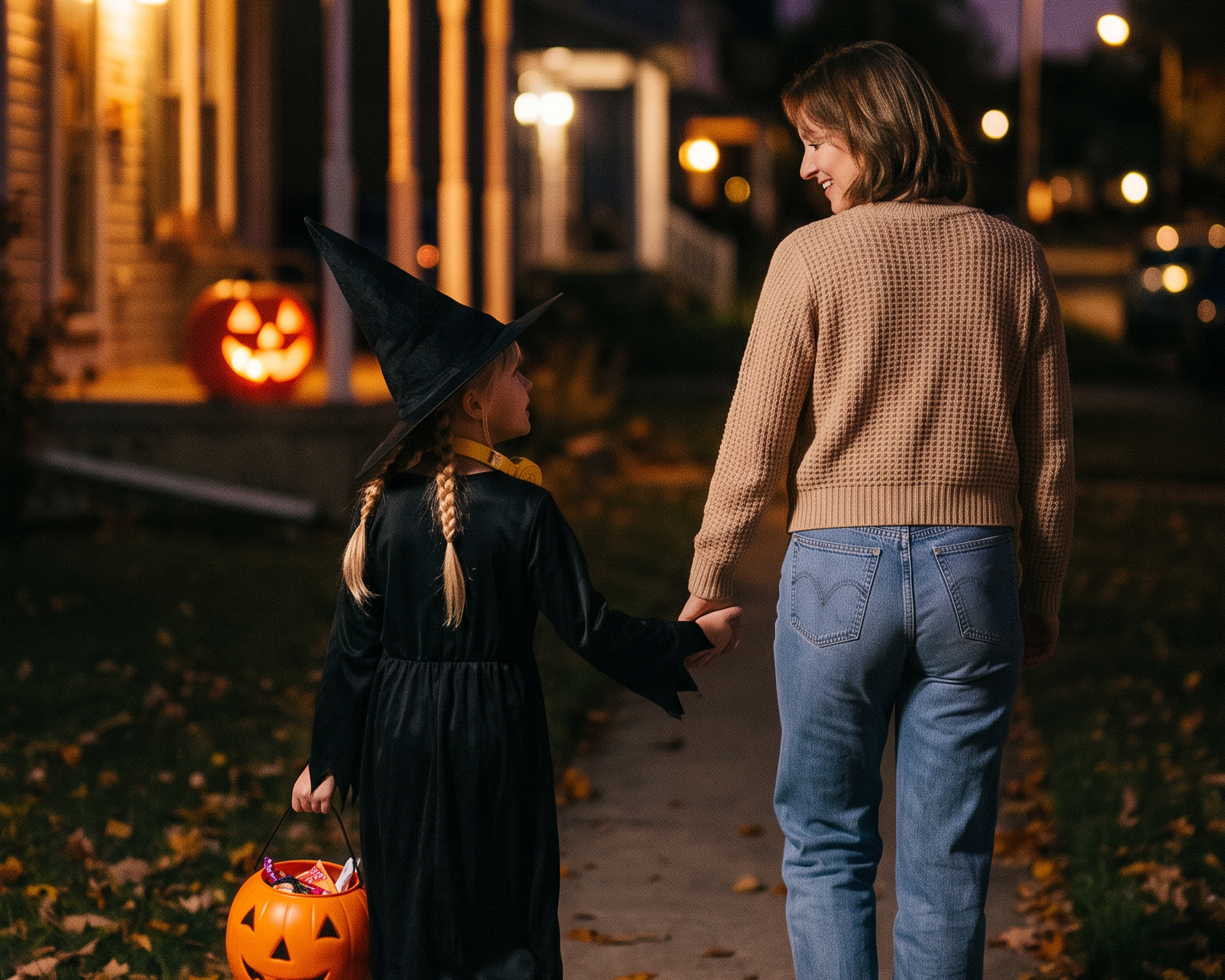
- Bringing noise-reducing headphones when appropriate.
- Visiting quieter neighborhoods or trick-or-treating earlier in the evening.
- Planning opportunities to rest in a calm environment.
Remember that sensory differences are individual. Some children may seek out exciting sensory experiences, while others may prefer quieter activities.
A child's comfort should take priority over expectations about how Halloween is supposed to look.
For additional guidance on costume safety and navigating Halloween activities, the American Academy of Pediatrics offers practical Halloween safety recommendations.
3. Support Communication Without Pressure
Traditional trick-or-treating involves several social expectations, including greeting unfamiliar adults, saying "trick or treat," and expressing gratitude.
For children with speech-language difficulties, social communication differences, or anxiety, these interactions may require additional preparation and support.
Some children communicate verbally, while others rely on gestures, visual supports, communication cards, or augmentative and alternative communication (AAC) systems.
Families can practice common interactions beforehand, but children should not feel pressured to communicate in a particular way to participate.
Adults can model greetings, allow additional processing time, and recognize nonverbal communication as equally meaningful.
The American Speech-Language-Hearing Association (ASHA) provides helpful strategies for supporting children with speech and language differences during Halloween, including the use of visual supports and alternative communication methods.
Inclusion means recognizing that communication looks different for every child.
4. Consider Executive Functioning and Emotional Regulation
Halloween requires children to manage excitement, follow directions, navigate unfamiliar situations, transition between activities, and monitor their behavior in busy environments.
These demands involve several executive functioning skills, including attention, impulse control, cognitive flexibility, planning, and self-regulation.
For children with ADHD or executive functioning challenges, the excitement of Halloween can make these skills more difficult to manage.
Families can provide support by:
- Establishing clear expectations before leaving home.
- Breaking the evening into manageable steps.
- Using visual reminders or timers when helpful.
- Offering movement or sensory breaks.
- Preparing children for transitions between activities.
- Developing a simple signal children can use when they need a break.
It is also important to recognize that emotional regulation may become more difficult when children are tired, overstimulated, or overwhelmed.
Rather than waiting until a child becomes distressed, caregivers can watch for early signs of discomfort and adjust expectations accordingly.
These strategies reflect a broader principle of supporting children with executive functioning differences: providing appropriate environmental supports can help children participate more successfully while building independence over time.
5. Prioritize Safety While Supporting Independence
Halloween presents additional safety considerations, particularly for children who experience difficulties with attention, impulse control, situational awareness, or recognizing potential dangers.
Before heading out, review pedestrian safety rules and establish clear expectations for remaining with an adult or designated group.
Families may also consider:
- Choosing familiar, well-lit routes.
- Practicing stopping and looking before crossing streets.
- Using reflective accessories or lights to improve visibility.
- Establishing a meeting location in case someone becomes separated.
- Providing individualized supervision for children who may wander or have difficulty recognizing unsafe situations.
For children who are developing greater independence, these routines offer opportunities to practice decision-making, following directions, and navigating community environments with appropriate support.
The American Academy of Pediatrics' Halloween safety guide provides additional recommendations for families.
6. Redefine What a Successful Halloween Looks Like
Perhaps the most important consideration is recognizing that Halloween does not have to look the same for every child.
Some children may enjoy visiting an entire neighborhood, while others may prefer a few familiar houses, attending a smaller gathering, helping distribute candy, or participating in a quiet celebration at home.
Children should have opportunities to make choices about their participation whenever possible.
A successful Halloween is not measured by the number of houses visited, whether a child wears a traditional costume, or whether they respond to social interactions in expected ways.
Instead, success means creating an environment in which children feel safe, included, supported, and able to participate meaningfully.
A Final Thought: Understanding the Individual Child
As a Licensed Educational Psychologist, I often emphasize the importance of understanding how individual differences in attention, executive functioning, sensory processing, communication, and emotional regulation influence a child's experiences.
While these factors frequently affect learning and participation in educational settings, they also influence everyday activities beyond the classroom.
Halloween offers a meaningful reminder that children do not all experience the world in the same way. When adults anticipate potential challenges, provide individualized supports, and remain flexible, they help create opportunities for greater confidence, independence, and inclusion.
This Halloween, let's focus less on expecting every child to participate in the same way and more on ensuring every child has an opportunity to feel included.
Because Halloween should be fun for every kid.